
INOUT Cricket Road Game
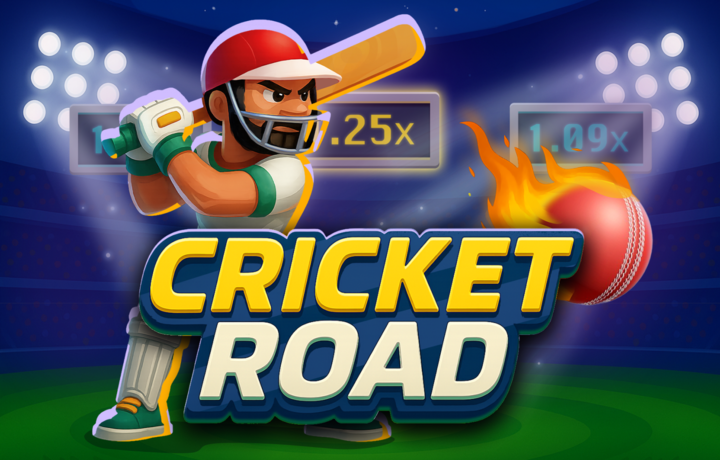
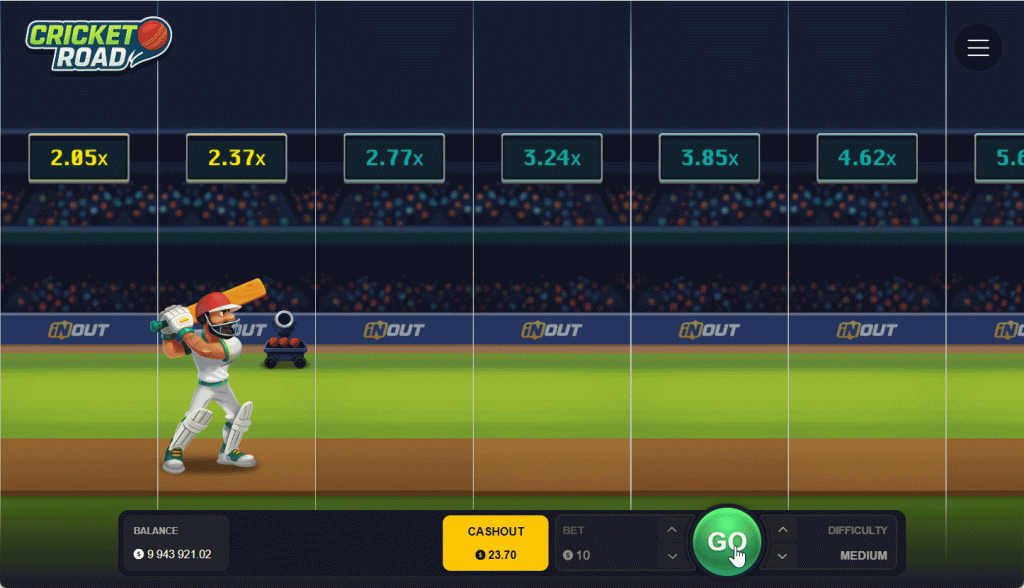
Cricket Road turns the familiar “Road” crash mechanics into a fast cricket challenge. You place a stake, pick a difficulty, and guide a batsman through incoming balls — every clean hit bumps the multiplier, every mistake ends the round with a wicket. Most sessions run 2–20 seconds, with quick choices and four risk tiers that swing volatility from gentle to brutal. Built on the same engine as Chicken Road and Rabbit Road, it’s a compact, sports-flavoured crash game where timing and cashout discipline decide everything.
Single-play
95.5% RTP
Release – 18.11.2025

| Feature | Short Description |
| Genre | Sports-themed crash / instant win game |
| Round Length | Fast 2–20 sec sessions |
| Difficulty Modes | 4 tiers: low-risk to high-risk volatility |
| Core Mechanic | Hit balls step-by-step, multiplier climbs each strike |
| Crash Event | One mistimed hit = wicket + loss of stake |
| RTP Range | ~95.5%–98% (operator-configured) |
| Max Multiplier | High-ceiling, Road-engine multipliers (x10,000+ possible in tuned versions) |
| Auto-Cashout | Optional preset cashout target |
| Theme | Cricket trophies, batsman lane, sports markers |
| Platforms | Browser/HTML5 – mobile & desktop |
| Provably Fair | Seed-based verification menu available |
Cricket Road Difficulty Levels
The four difficulty tiers reshape how the game behaves, changing both the tempo of hits and the pace at which the multiplier grows. Whether someone prefers calm runs or sharp volatility, each tier introduces its own rhythm — and INOUT Cricket Road game quietly rewards players who know when to stop.
Easy
The Easy tier is where most players get their first feel for the system. Early hits tend to land cleanly, and the multiplier rises in gentle steps such as x1.10 → x1.25 → x1.40.
A simple example: someone puts $5 on the line and walks away at x2, usually after 6–8 safe swings. It’s a soft introduction to the mechanics, especially for players easing into Cricket Road without taking heavy risks.
Medium
Here, the game starts to wake up. Safe hits are still common, but the flow becomes less predictable, and the multiplier might climb in jumps like x1.2 → x1.6 → x2.4 → x3.1.
If a player stakes $10 and aims for around x3, they’re looking at roughly $30, but runs end more suddenly compared to the first tier. Medium is the point where Cricket Road INOUT Games shifts from “relaxed” to “engaging.”
Hard Cricket Road Game
In Hard mode, the tone changes sharply. Hit windows narrow, and the multiplier spikes can get dramatic — x1.4 → x2.3 → x4.8, for example — but each step feels like it could be the last.
A realistic round: a $20 stake taken to x6 becomes $120, although most attempts won’t stretch that far. Players who pick this tier are usually ready to accept frequent wickets in exchange for bigger middle-range payouts.
Hardcore
Hardcore doesn’t pretend to be fair or forgiving; it’s designed for volatility chasers. Safe hits get rare, and multiplier leaps can look like x1.5 → x7 → x15, provided the player survives long enough.
High-risk players sometimes push $50 to x20 for a $1,000 result — but plenty of Hardcore rounds in Cricket Road stop before x3. The thrill is obvious, but so is the danger.
Core Gameplay Mechanics
Cricket Road game operates on a fast, decision-driven loop, where every hit carries weight. Rounds last only a few seconds, but within that short window, the player controls the risk: when to swing, when to cash out, and when to push for one more multiplier step. The game maintains a tight flow, so even small bets feel dynamic, and larger ones become genuinely tense. Here’s how the core sequence works in practice:
- Stake & Start: Players set a wager — often $2–$5 for safe tests or $20–$50 for more ambitious rounds — and the batsman enters play immediately as the first ball approaches.
- Hit-by-Hit Progress: Every clean strike moves the run forward and lifts the multiplier, usually beginning with gentle climbs like x1.10 → x1.22 → x1.35, while higher difficulties can trigger early jumps to x3 or x5 within seconds.
- Multiplier Growth: On easier settings, most rounds settle around x1.5–x2.5 before players cash out. In tougher modes, a $10 bet reaching x6 turns into $60, though runs end more abruptly due to tighter hit windows.
- Cashout Timing: Players can withdraw at any moment — a cautious user may lock in x1.5 and convert $5 into $7.50, while a risk-focused player may hold for x10, knowing the next ball could drop the round instantly.
- Wicket (Crash): A single mistimed strike stops the multiplier and ends the round. Most wickets occur between x1.1–x3, but occasional long stretches encourage players to push further than planned.
- Instant Restart: Once the round ends, the game reloads immediately, allowing rapid back-to-back attempts with new stakes, difficulty levels, or targets.
Game Fairness
Fairness is handled through a provably fair seed system where every crash point can be verified after the round. Players can open the fairness panel in Cricket Road INOUT Games to see the exact server and player seeds used.
- Seed Logic: A server seed + player seeds generate the crash hash, revealed once the round ends.
- No Bet Influence: Results are fixed before the first hit, so a $5 and $50 stake follow the same logic.
- Verification: Seeds can be checked through external tools for independent confirmation.Uniform Across Modes: All difficulty levels use the same fairness structure; only risk changes.
FAQ
How do I move the batsman forward on each tile?
You tap or click once per step. Each input triggers the next delivery, and a clean strike moves the batsman to the next tile automatically.
Does every step increase the multiplier like in crash-style games?
Yes. Each safe hit bumps the multiplier upward. The rate of growth depends on the selected difficulty, but every successful step adds value.
Do the lanes change difficulty as I progress?
No. The difficulty is fixed by the mode you choose at the start. The lane doesn’t get harder tile-by-tile; the risk pattern stays consistent for the entire run.
What is the minimum and maximum bet in Cricket Road?
Bet limits depend on the operator. Most versions allow very low entries (e.g., the equivalent of 0.10 units) and caps 200 units per round, though casinos can configure higher ceilings.
Can I switch between difficulties in demo mode?
Yes. Demo mode lets you move freely between Easy, Medium, Hard, and Hardcore without restrictions.
Is an APK version available?
Some casinos provide an APK for Android users, but it’s operator-specific. The base version of Cricket Road is fully browser-based and doesn’t require installation.
Can operators adjust volatility or tile distribution?
Yes. INOUT’s backend allows partners to tune volatility bands and tile frequency patterns within approved ranges, similar to other Road-series integrations.
What is the average integration time?
Most casinos integrate Road-series titles in 24–72 hours, depending on the platform and existing crash suite setup.
Are multipliers optimized for long-session behavior?
Yes. The math model is tuned for stability across hundreds of rounds, not just isolated spikes. Long-session players see predictable volatility curves based on difficulty choice.
Does the UI allow operator logo placement?
Yes. The top bar and loading screen both support operator-provided brand elements, and many partners place their logo in the interface for consistency.