
Plinko 1000
Built around a mathematically certified 96% fixed RTP, Plinko 1000 delivers uncompromising volatility control through a scalable 8- to 16-row pegboard. We engineered this title to provide transparent risk management across 17 distinct payout slots, allowing players to instantly calibrate their sessions from low-variance baseline returns up to a maximum 1,000x multiplier.
Single-play
96% RTP
Release – 19.07.2023
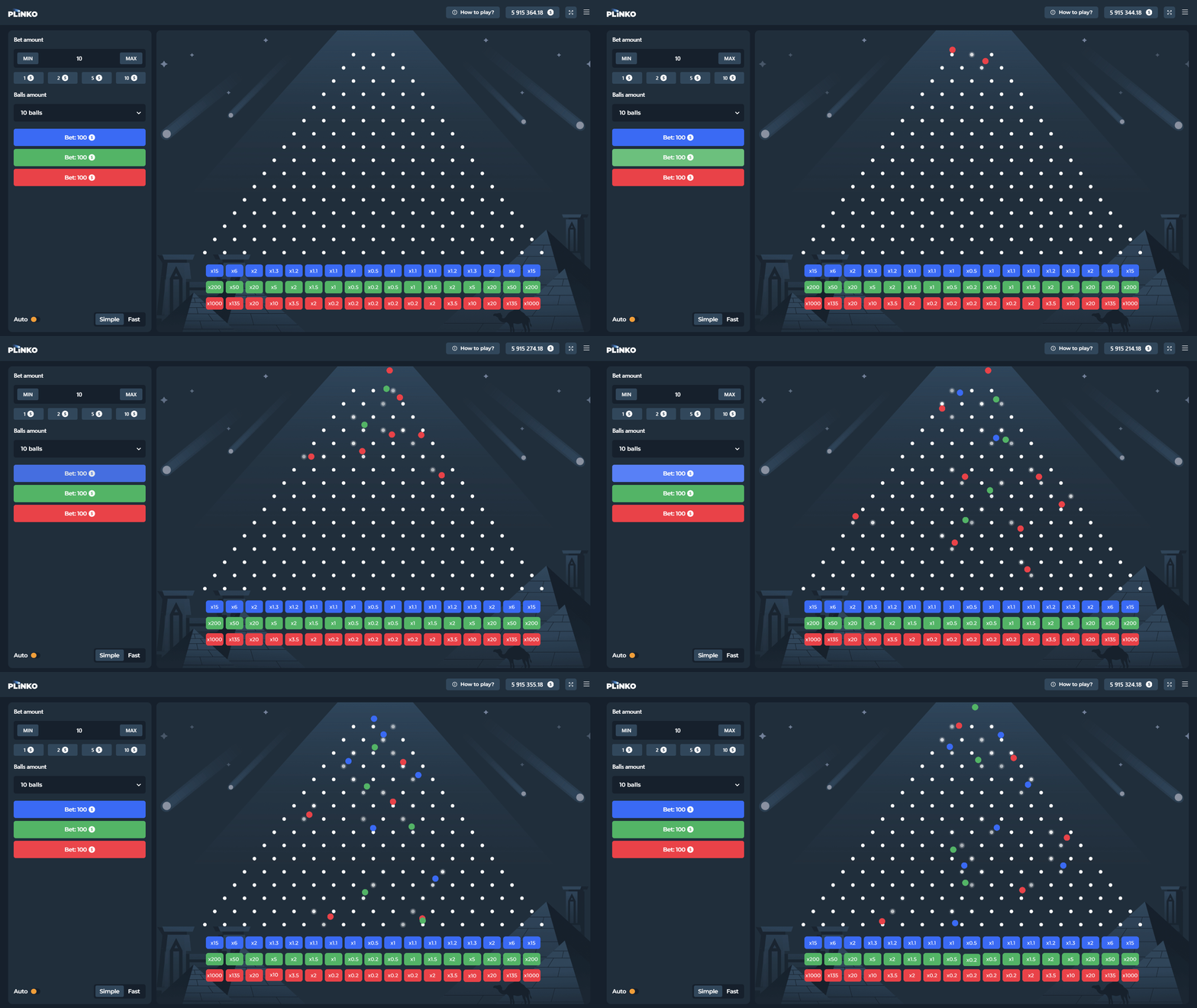
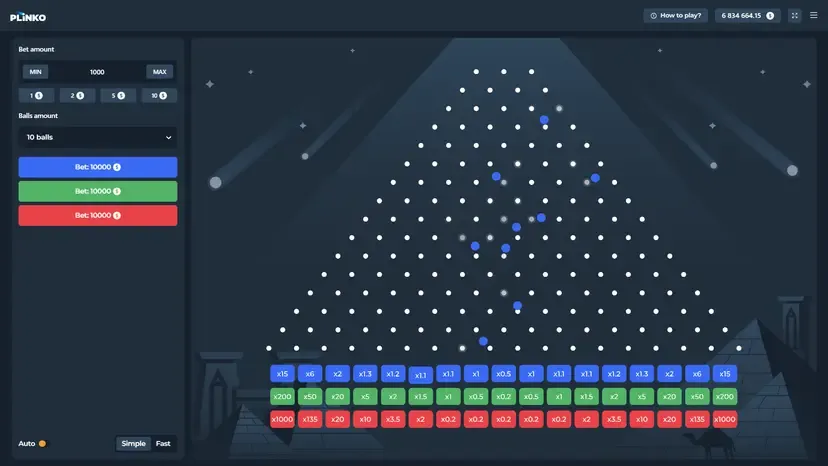
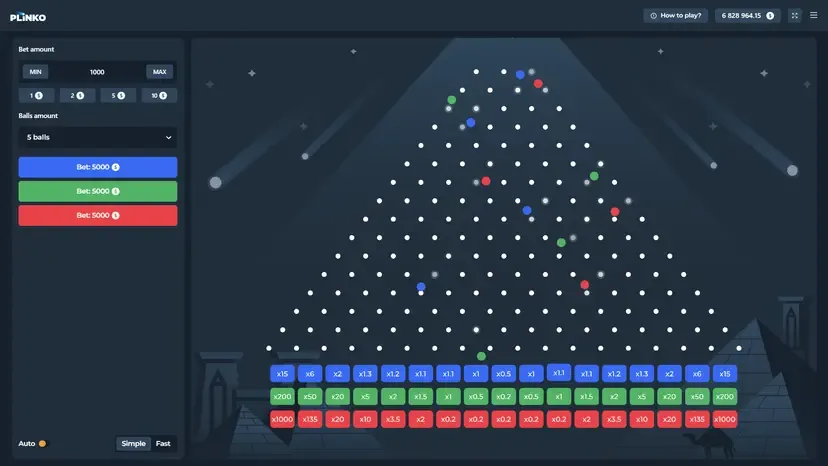
| Core Metric | Technical Specification |
| Game Format | Peg-Based Plinko / Crash-Style |
| RTP (Return to Player) | 96.00% (Certified Fixed) |
| Maximum Payout | 1,000x Stake |
| Grid Architecture | Configurable Pyramid (8 to 16 Rows) |
| Target Distribution | 17 Distinct Multiplier Slots |
| Volatility Control | 3-Tier User Selection (Low/Blue, Medium/Green, High/Red) |
| Execution Features | Multi-Ball Drop (Up to 50 balls), Auto-Play, Fast-Play |
| Visual Theme | Minimalist Ancient Egypt |
Play Plinko 1000 Demo Game
Stress-test our math model firsthand. The Plinko 1000 demo provides unrestricted, free access to all core mechanics, allowing you to run high-volume simulated sessions across the 8-to-16 row layouts and verify the exact variance of our 96% RTP engine before staking real capital. To guarantee precise market replication, we engineered the test environment with full UI localization—enabling you to instantly customize the demo across a comprehensive range of global languages and active fiat or crypto currencies.
Game RTP and Volatility
At the core of Plinko 1000 is a certified 96.00% Return to Player (RTP). As an operator, this is the fixed baseline. However, the true strength of this math model lies in player-controlled volatility. You dictate the exact dispersion of returns by adjusting the grid size (8 to 16 rows) and targeting specific payout color modes.
- Low Volatility (Blue Mode | 8 Rows): Concentrates probability mass in the center slots. Expect frequent, low-variance payouts ranging from 0.2x to 3x. This configuration minimizes drawdown, making it strictly optimal for long-session grinding and high-volume capital turnover.
- Medium Volatility (Green Mode | 10–12 Rows): Balances the distribution. Inner slots maintain a steady baseline, while edge probabilities shift to support occasional 50x spikes. Engineered for players seeking moderate risk exposure without rapid balance depletion.
- High Volatility (Red Mode | 14–16 Rows): The maximum variance configuration. Probability is stretched thin to fund the extreme edge slots. Players will endure high-frequency 0.2x and 0.5x misses in exchange for the mathematical possibility of hitting the strictly capped 1,000x multiplier.
Plinko 1000 Board Layout Structure
The architectural foundation of Plinko 1000 game is a symmetrical, scalable pegboard. As balls descend, their pseudo-random paths dictate their final resting place across 17 distinct payout slots. Because the math engine operates on strict edge-slot physics—where extreme outer slots hold the highest multipliers but the lowest hit probabilities—the board is segregated into three distinct risk matrices. This gives players absolute, transparent control over their session variance.
Blue Payout Row
- Volatility Profile: Low / Baseline
- Optimal Grid Setup: 8 Rows
- Execution Volume: 10–20 Balls per Drop
- Multiplier Spread: 0.2x to 3.0x
Execution Strategy: The Blue matrix is built strictly for capital retention. By utilizing an 8-row configuration in Plinko 1000, the underlying math heavily centralizes hit probability, generating frequent returns in the 0.2x to 1.5x range. This setup actively prevents rapid drawdown and is the mathematically optimal configuration for high-volume wagering and long-session grinding.
Green Payout Row
- Volatility Profile: Moderate
- Optimal Grid Setup: 10–12 Rows
- Execution Volume: 5–10 Balls per Drop
- Multiplier Spread: 0.2x to 50.0x
Execution Strategy: The Green row introduces moderate probability dispersion. It balances inner-slot balance retention with mid-tier edge spikes, frequently landing hits in the 8x to 30x range. This tier is engineered for the “maintain-and-spike” Plinko 1000 strategy, providing enough structural variance to capture meaningful multipliers without exposing the player to severe dry streaks.
Red Payout Row
- Volatility Profile: Maximum Exposure
- Optimal Grid Setup: 14–16 Rows
- Execution Volume: 1–5 Balls per Drop
- Multiplier Spread: 0.2x to 1,000x
Execution Strategy: The Red matrix is the high-volatility engine of Plinko 1000 game. Operating on 14 to 16 rows, the game intentionally starves the center slots—forcing frequent 0.2x to 0.5x misses—to fund extreme payouts on the periphery mathematically. This is a pure exposure setup built strictly for players hunting the hard-capped 1,000x maximum multiplier.
How to Play in Plinko 1000 by InOut Games?
Executing a session on Plinko 1000 requires precise configuration. Unlike standard slots, you dictate the mathematical framework of every drop before risking capital.
Place the Bet
- Per-Ball Sizing: Wagers apply strictly to each individual ball.
- Bet Limits: Stake sizes typically range from a 0.10 coin minimum to a 100.00 coin maximum per ball (operator dependent).
- Total Exposure: Calculate your total wager before dropping. A 2.00 coin bet deployed across 20 balls equals a 40.00 coin total session stake.
Choosing the Number of Balls
- Volume Control: Drop between 1 and 50 balls per execution.
- High Volume (20–50 balls): Smooths short-term variance. Generates rapid data points that track closer to the fixed 96% RTP baseline.
- Low Volume (1–5 balls): Maximizes short-term volatility. Increases the probability of extreme statistical deviations.
Pick the Difficulty of Payout Row
- First, set the board depth between 8 and 16 rows. More rows push the highest mathematical multipliers to the extreme edges. Then, lock in your payout matrix:
- Blue (Low Risk): Condenses hit probability to the center. Maximum edge multiplier is capped at 3.0x.
- Green (Medium Risk): Balances dispersion. Mid-tier edge spikes can reach up to 50.0x.
- Red (High Risk): Unlocks the absolute periphery. Exposes the mathematically capped 1,000x multiplier while drastically increasing inner-slot misses.
Auto or Manual Betting at Plinko 1000
- Manual Mode (“Drop”): Requires individual input per round. Optimal for actively calibrating stake size and row counts based on live results.
- Auto-Play: Built for high-volume execution. Lock in fixed parameters (e.g., Red Mode, 16 Rows, 5 balls) for automated repetition.
- Fast Play: Bypasses visual peg-bounce animations. Instantly resolves the certified RNG calculation to credit results and maximize turnover efficiency.
Measures Used for Fairness
Trust in Plinko 1000 is mathematically proven. We operate on a strict Provably Fair algorithm using cryptographic server and client seeds. This eliminates operator manipulation, allowing players to independently verify post-round hashes to guarantee every outcome was locked before the ball ever dropped.
This cryptographic framework is backed by an independently certified RNG engine that rigidly enforces the 96.00% fixed RTP across all 17 slots. Because the system is deterministic, your final multiplier is calculated exactly the moment you initiate a drop. The visual peg-bounces simply execute the already-secured math.
Adaptation for Mobile and Plinko 1000 App Play
Engineered natively in HTML5, Plinko 1000 game delivers zero-latency execution across all iOS, Android, and desktop environments. The architecture is specifically structured for maximum session retention, operating flawlessly whether accessed via mobile browser or embedded within a dedicated casino app.
For Casino Operators (B2B Infrastructure)
- Frictionless Integration: Deploys instantly via API/iframe into any proprietary casino wrapper or existing aggregator platform.
- Minimized Asset Payload: The highly compressed code footprint guarantees sub-second initial load speeds, actively preventing drop-offs on low-tier mobile networks.
- Responsive Scaling: Full backend UI localization and multi-currency inputs (fiat and crypto) automatically resize to fit any mobile viewport without breaking layout logic.
For Players (B2C Execution)
- Portrait-Optimized UI: The 16-row pyramid grid naturally aligns with vertical screens, engineered specifically for flawless, one-handed mobile play.
- Precision Controls: Enlarged, tactile hit-boxes for the stake slider and ‘Drop’ buttons prevent expensive misclicks when managing bets up to 100.00 coins.
- Battery & Frame-Rate Efficient: The game’s deterministic visual rendering locks in at a stable 60 FPS, ensuring zero lag during high-volume, 50-ball auto-play sessions without draining device batteries.
Casino Operators Customization
Plinko 1000 is engineered for rapid B2B scalability. Our lightweight API framework allows operators to deploy the game into existing aggregators or proprietary backend systems in under 24 hours with zero operational downtime.
The front-end architecture is strictly white-labeled to maximize your brand retention. Operators can embed custom logos directly into the game UI, instantly localize the interface across multiple global languages, and execute wagers in any native fiat or cryptocurrency protocol to ensure frictionless player onboarding.
FAQ
How do you play Plinko 1000 game?
Set your base stake per ball, configure the grid depth (8 to 16 rows), and select your risk matrix (Blue, Green, or Red). Once your volatility parameters are locked, drop between 1 and 50 balls per execution to hit multiplier slots at the bottom of the board.
What is the maximum win?
The math model is strictly capped at a 1,000x maximum multiplier. To access this probability, you must force maximum board variance by running Red Mode on 14 or 16 rows, which targets the outermost edge slots.
Are there bonus features or free spins?
No. Plinko 1000 is a pure crash-style probability game. There are no reels, scatters, or free spin rounds—just a mathematically certified 96.00% RTP engine where the player has absolute control over the execution and variance of every drop.
What are the minimum and maximum bets?
Standard B2B configurations allow a 0.10 coin minimum and a 100.00 coin maximum per ball. Because the engine allows you to drop up to 50 balls simultaneously, operators and players must accurately calculate total stake exposure before initiating a round.
How is Plinko 1000 different from regular Plinko games?
It upgrades the traditional baseline model by engineering a 1,000x maximum win capacity within a minimalist Ancient Egypt UI. More importantly, it features an exact 17-slot base architecture that dynamically shifts probability distribution depending on your selected risk matrix, rather than just adding random pegs.
How many rows and slots are there?
Players customize the pyramid grid between 8 and 16 rows. Regardless of the row depth you select, every ball resolves into one of exactly 17 distinct payout slots at the bottom of the board.